Posts

Showing posts with the label The horse - buildings

Camden Stables – in Search of Horse Ghosts

Image
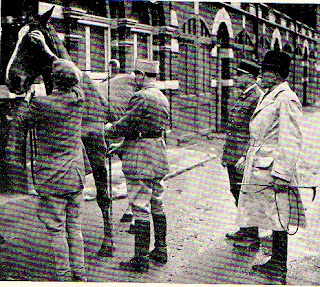
In most towns and cities, you can probably, if you look hard enough, find evidence of the working horse, even if it’s just in the names of streets. And although many buildings have disappeared entirely, some still survive, even if they have found other uses entirely. One such is the railway stables that served the goods yards of Euston Station and the surrounding canals. Inner city stables like these housed an astonishing number of horses, often in surprisingly small spaces. If you are used to the open spaces of most modern yards, it’s difficult to imagine that once hundreds of horses were stabled around Chalk Farm Road, in what has become known as Camden Stables. At its peak, the goods stables housed 700–800 horses, with more stables at the termini for those horses who transported passengers. © IWM (D 16820) The first run of stables was built in 1839, but they and the surrounding buildings saw decades of expansion and rebuilding. The earliest range of stables th...
A supermarket for horses: the Horse Bazaar of Baker Street

Image
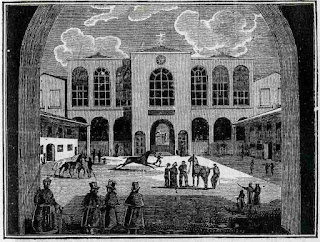
The vast shopping centre is something we’re all used to, but it’s not where you’d go if you wanted to buy a horse. In the early years of the 19th century, it is exactly where you would have gone, particularly if you’d wanted to mix with the fashionable. I must admit that before this week, I’d not given a great deal of thought to how horses were bought and sold in the nineteenth century, but I was asked if I knew about a riding school that had once existed in King Street, off Baker Street in London. I didn’t, but I investigated. I found that there had been a riding school which occupied the former King Street Barracks, established in 1822. And it was far, far more than a riding school. Whatever your equine need, the Horse Bazaar could meet it: horses, carriages, equipment – it was all there. Horace Wellbeloved MA wrote an 1826 guidebook for visitors to London so that they missed none of the delights it had to offer. London Lions for Country Cousins and Beyond included the Horse Baza...

The Cadogan Riding School and the Second World War

Image
I wrote a while back about the fate of the Cadogan Riding School in the Second World War, and had thought that its destruction was a terrible tragedy, but this wasn’t owner Horace Smith’s attitude at all.   The War came, he said, when there was a 'very bad depression' in the horse world, affecting both Cadogan's dealing and riding school businesses.   Their outgoings in 1939 were very high indeed; they had 250 horses, a large staff and high overheads.   The outbreak of war was actually a help as the Government bought nearly all their horses, though Cadogan lost money on them.   Unlike those owners Josephine Pullein-Thompson described, who shot their horses rather than see them taken for military service, Horace Smith made active efforts to shift his. Each county had a different purchasing officer, and if a certain officer cast any of my horses for some small reason – such as their being either too small, or too big – I sent them into another county for inspectio...

Another old smithy - Carlton on Trent

Image
The visit to the blacksmith's was a helpful plot device for so many pony books; all lost now the farrier comes to you, though there is of course the long wait until the farrier turns up, the sudden dearth of mobile phone contact from said farrier as you wait about, the deep frustration as you finally give up, and then the twilight trek up to the field, armed with threats as you spot someone trudging around there after the horses, only to find it is the farrier, turned up at last. Below is the traditional scene beloved of pony books: and here, because I am on a bit of an old equestrian building mission at the moment, is another smithy: this one is at Carlton-on-Trent, and the picture comes from Riding Magazine, July-Sept 1944. At that time, the occupant was F Naylor, who put up the noticeboard with the verse. F Egerton, who sent in the picture, sent in the text of the verse as well: Gentlemen as you pass by upon this Shoe pray cast an eye; If it be too strait I'll make ...

Equine buildings - the blacksmith's, Roxby

Image
I came across the photograph below in a World War II copy of Riding magazine from Jan-March 1943. Riding was then down to 4 issues every year, down from the monthly pre-war issue rate. The war was reflected, however briefly, in much of the correspondence columns. J D Robinson contributed this photograph, which is of a blacksmith's shop at Roxby, North Yorkshire, purely so readers of the magazine could see it - a small break from the pressures of war. Another correspondent in the same issue talked of the importance of being able to have some relaxation so that war work could be carried on - "The Managing Director of a certain aircraft factory puts in a superhuman number of hours on the job... He has turned to the horse now, and relies on this to give him the brief relaxation necessary to enable him to carry on work at such terrific pressure." Looking at this building must have had a little of the same affect. I have never seen anything like it, and my immediate...