Posts

Showing posts with the label Pony books - early

And then... Pony Books in the 1940s

Image
After Joanna Cannan introduced her heroine Jean to the world in A Pony for Jean (1936), she opened the gate to a fresh wave of stories. Ann Stafford wrote a fine holiday adventure in Five Proud Riders (1937) , with young authors Katharine Hull and Pamela Whitlock contributing decent examples of ponies and holidays in their Oxus  series in the late 1930s ( The Far-Distant Oxus, 1937, Escape to Persia, 1938, Oxus in Summer, 1939 ). With the outbreak of World War II in 1939, children's books were hit in several ways. Authors were otherwise occupied, doing war work. There was a paper shortage, leading to fewer books being published, and the introduction of the War Economy standard, with poorer quality paper and short print runs. (Ironically, these books are still surviving quite happily over 70 years later; many in considerably better shape than books produced a decade ago.) Books were lost when London was bombed. Moyra Charlton's Echoing Horn (1939)   had most of its print ...

The pony book - how it all began

Image
Animal books there were in plenty in the 1800s: animals telling their own story. There were cats, dogs, the occasional pony, and donkeys, and then in 1877 came Anna Sewell's Black Beauty . Black Beauty told the world what it was like to be a working horse in Victorian Britain. It was a success virtually from the start, with Anna Sewell surviving just long enough to see it. Sadly she and her family benefited very little from the book's remarkable sales: Anna had been advised by her author mother to sell the copyright. She did, for £20. Publishers Jarrolds did very nicely thank you out of this: American publishers did too. Although the copyright was Jarrolds', Black Beauty was pirated in the United States and those editions sold massively there. Black Beauty set the pattern for what was to come: horses and ponies telling their own story. There were lots of them; a very few good, but most of them repetitive accounts of idyllic foalhoods, wonderful first owners, a sad sal...

The Young Entry (or at least some of them)

I’ve recently read a few books by very young writers.  Normally this is a genre I avoid like the plague.  Colonel C E G Hope, later editor of Pony Magazine, wrote when he was working for Riding: “I find that I have to overcome a certain, no doubt unreasonable, prejudice when dealing with books by children...”  I have a lot of sympathy for Colonel Hope’s point of view.  Once I made the mistake of reviewing a book written by a child, a review which I thought was basically sympathetic, but oh goodness, the flack I received for daring to say something even slightly negative (which I did, I admit, about the book’s editors).  That was the first, and only, blog piece I have ever taken down.  I have learned my lesson, and intend not to touch with a bargepole anything written by the young today. Colonel Hope had a good deal to contend with in avoiding the book written by the child: they were not exactly uncommon in the 1930s, which is when this set of books was pub...

Ponies for Children: Margaret Williamson

Image
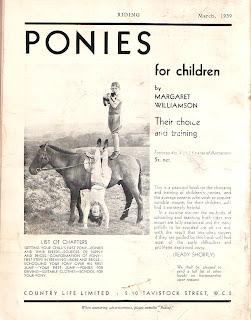
Nowadays, publishing a book with a cover like this would get you a flaming on Fugly, to say the least.  In 1939, Country Life's publication of Margaret Williamson's Ponies for Children was reviewed in Riding Magazine thus: "This is a useful book for that patient, and often harassed person, the parent of the child who rides, or wants to ride, a pony....  The book may seem on the short side; but on the other hand it is full of good, sound, easily accessible information, without any padding."

The nasty side of life

Image
I tend to think of the 1920s as a generation rather tougher than our own, and less inclined to edit out the nasty side of life for our children.  It wasn't necessarily so, however:  author and illustrator  Allen Seaby  wrote several pony stories in the 1920s about British native ponies.  According to the foreword to his  Dinah the Dartmoor,  the first edition dustjacket of his  Skewbald the New Forest Pony,  published in 1923 was objected to because it showed a picture of two ponies fighting.  Seaby had to produce the version seen on very many reprints since, which was considered "less inciting to evil." I still haven't seen a first edition dustjacket, but I now have a first edition.  Here it is.  I assume that, like later reprints, the illustration on the boards mirrored the one on the dustjacket. This is the reprint: - a sweetly domestic and maternal scene.  None of those nasty fighting males.